Monday, March 23, 2015

IHS in Prague

So some internet issues prevented me from posting this until now.  By now the group has likely landed in Houston, but I'm sure they will want me to post this anyway.  I promised a happier post, and it coincides nicely with the joy of seeing your kids again!

After leaving Auschwitz, we headed by bus to Prague.  We stopped briefly for lunch, then drove on--Tess loved the roads!--and arrived in Prague in the late afternoon.  We left most of our stuff on the bus and walked across the Vlatava (Moldau) River to the Old Town Square and dinner.  We had a bit of time to explore the square and change money.  Students were pleased to discover that the Easter festival was already open--numerous booths selling food and souveniers.  The whole square was decorated, and we learned about some of the Czech Easter traditions (apparently it’s a BIG holiday here).  Then it was off to the hotel and some much-needed rest.

Old Town Square cathedral

Why yes, the kids are standing outside the bar--what you can't see in the picture is that the ATM was beside that door, and that's why they were there.  They did not go in the bar.

See?  Proof!  Tess liked the 25:1 exchange rate.  She is holding up $80.

Jacob, Sarah, and Aaron check out the craft booths


Justice likes the decorations

 Sunday was our only overcast day of the entire trip, and it was, unfortunately, a bit colder (though at low 40s as the coldest day and almost all sunshine, we really can’t complain about the weather).  We started with a walking tour of the Jewish district.  Our tour guide Simona walked us through the history of the Czech Jews--their restrictions (ghettos through most of the middle ages), protections (they were property of the king, so they actually enjoyed some protections--ironic, right?), and even a bit about how they “bought” their last names.  It was fascinating.  Jews were finally given full recognition and equality in the mid-1800s, only to suffer persecution when Nazi Germany annexed Czechoslovakia in 1938.  Of the country’s 90,000 Jews, only 10,000 survived the war.  The names of the 80,000 who perished (most of whom went through Terezin/Theresienstadt, a unique concentration camp) were written on the walls of the synagogue we saw.  We also saw artwork from children in the camps.  80,000 names takes up a LOT of space--several rooms had walls covered in names.  That gave students an idea of scope.  Unfortunately, photographs were forbidden.

We moved back outside to the old cemetery, which was used from the mid-1400s to the late 1700s.  Because it was the only place to bury Jews of Prague for so long, bodies were stacked up to 12 deep.  There are at least 12,000 headstones, and nobody knows how many people are buried there.  The most interesting grave was that of Rabbi Löw, and students learned the legend of the Golem.  Because of the stacking, the graveyard is now two stories tall.


Really old gravestones

Rabbi Löw is buried here

That's the cemetery up there!


We headed over to the Old New Synagogue, which is still in use today as it has been for hundreds of years.  There we saw a red banner with a six-pointed star--the symbol of Prague’s Jews.  This is the first known use of what we now call the Star of David, and it is thought that the six points represented the six gates out of the Jewish District of Prague.  That was fascinating!  After a brief stop at a statue of one of Prague’s most famous Jews, Franz Kafka, we went into the Spanish Synagogue, where we learned about the Sephardic Jews and the Moorish influence on the building.  The display of silver in here was impressive!
The Jewish district

The Hebrew clock (below) runs backwards from what we know, and the short hand is the minute hand while the large one is the hour hand.  Unfortunately, we happened to be there at 11:05, which is right when the two clocks match up.


Kafka

His most famous work was Metamorphosis, in which the protagonist wakes up as a cockroach.  Thus the statue is on a roach.

Inside the Spanish Synagogue (no flash allowed)


Can you see the Moorish influence?

This looked fun!

Stolpersteine, or stumbling stones, are all over Germany and now in many places in Europe.  They are placed in front of a house and have the words "Here lived" and the name and fate of the resident who was a victim of the Holocaust.

We then headed back to the square for lunch before boarding our bus to head up to Prague Castle.  This place is 87x bigger than the White House grounds and the biggest castle in the world.  It is actually a castle complex at the top of the hill.  We watched a changing of the guard and enjoyed some photos before going into the cathedral.  It was constructed between 1340 and 1930, and it was massive!  The crypt below, which is not open to visitors, holds the grave of Charles IV, the most famous Czech king.  However, we did see the grave of St. John Nepomouk and learned the story of St. Vitus, who was thrown in a vat of boiling oil by his father for converting to Christianity.  The crown jewels are housed above the grave of their owner, King Wenceslas, and are only taken out a few times each century with the seven owners of the seven keys deciding that.

Blacksmith making crafts for the market

Easter market at Old Town Square


We enjoyed the courtyards, the Kafka house, and armory exhibit in that district.  Practically everything there predates the “discovery” of America by Columbus, and much of it is even before the Vikings came across the Atlantic.  Crazy!  Impressions from the castle:


 The view from Castle Hill


Hot chocolate in a cafe in the castle

Heading back down the hill 

 Tess, are you confused?


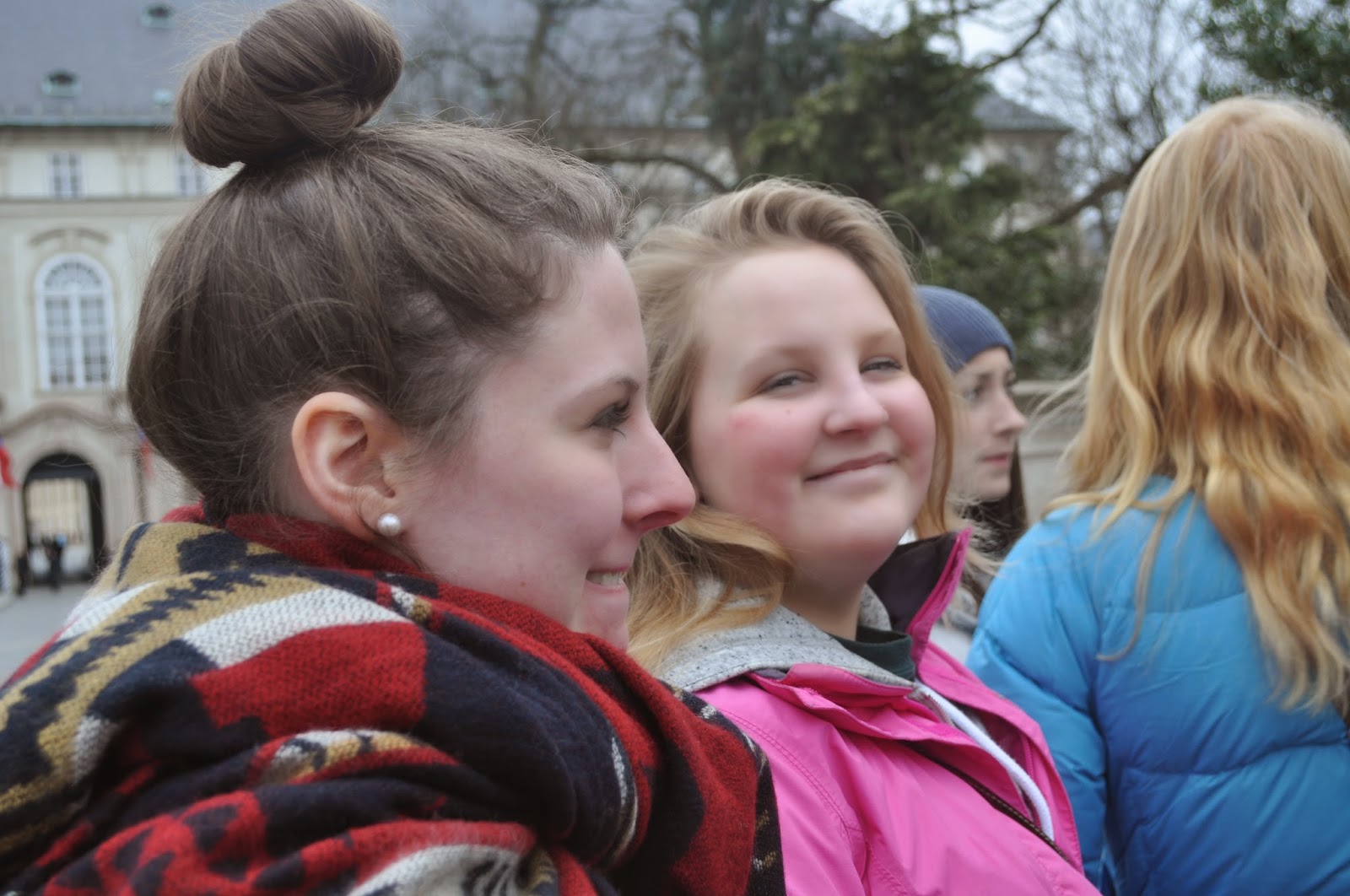
Seniors in Prague


Most of the group enjoyed the view, but Hailey and Justice made new friends


Archer houses (the blue one was home to Kafka for awhile) on the castle wall have small doors and create a cute alley


We walked down and across the Charles Bridge, where we got to the statue of St. Nepomouk.  Legend says that if you touch the engraving on the right side with your left hand, you can make a wish.  If you touch the left side with your right hand, you will come back to Prague.  Students enjoyed doing that, and they loved the artisans on the bridge.  Then it was back to the Old Town Square, where we took advantage of the market to listen to live music, feed the goats and sheep on display, and marvel at the crafts.  We even got to see the Astronomical Clock and hear the trumpeter.  The bell ringing in the hour is “rung” by a skeleton, who nods to indicate death will come to all.  Beside him, three men representing sins shake their heads saying they don’t want to go.  Above them, the disciples parade by.  Then the rooster crows, symbolizing a new beginning.  This is every hour, and it was fun to watch.


Justice wants to come back while Sera makes a wish


Free time in the square:


Kindred spirits


We enjoyed our last dinner in Europe with violin and guitar music.  Then a few students from both groups were feeling a bit under the weather.  We took a cab back to the hotel while the rest went on a night cruise of the Vlatava, seeing the City of 1000 Spires by night from the water.  Good times!


With Jonah!


Cameron, please tell us what Hailey is doing!


Overall this city was a huge hit--very pretty, old cobbled streets everywhere, and just plain fun.  They were all sorry to see the trip end!


Virtually all of the streets looked like this--lovely facades everywhere in the city

This morning they boarded a plane back to Frankfurt while I took the train to Hamburg.  At last check in Gus said they were boarding in Frankfurt and all was well.  They will be tired, but we think everyone had fun and has stories and memories to last a lifetime.  Expect full brains, full suitcases, and big smiles at the airport.  Europe 2015 was a hit!

Sunday, March 22, 2015

IHS at Auschwitz

Warning:  This post is a bit grim, as our time at Auschwitz was grim.  Rest assured they all handled it well.  I have given you considerable detail so that you can learn and process with them as you see fit.

So Saturday began early with a 5:30 wake up call.  We boarded our bus and headed to the town of Oswiecim and its camp, Auschwitz.

Outside the gates

We began in Auschwitz I, the first camp and followed this up with a visit to Auschwitz II, also known as Birkenau.  Somehow it seemed wrong to take photos of the students during this visit, so we will simply share what we saw and learned and leave the photos of the location to speak for themselves.  Students were issued headphones connected to our guide's microphone so she could speak softly and we could move a bit apart to take things in with a bit of physical and emotional space.

At Auschwitz, we entered under the "Arbeit macht frei" sign where prisoners were stripped of their civilian clothes and names.  We saw the brick barracks, which were originally Polish military barracks.  Inside several of them were exhibitions describing the origins of the camp for Soviet POWs and Polish political prisoners.  The exhibits got grimmer as we saw cans of Zyklon B gas, shoes worn by the victims at their arrival, carefully labeled suitcases the owners had expected to reclaim, prosthetic limbs, shaving kits, and numerous photographs and maps.  However, it was the human hair that was particularly difficult to see.  Photos were not permitted here, nor could I have managed to take any.

Work does not make free.  It bought people a reprieve, typically 2-4 months

The fences were electrified (fatal shock), and the zone just beyond was also fatal as guards in the tower like the one pictured would shoot.  The building with many chimneys is the camp kitchen.


The rows of barracks with the tower and fence beyond

Human ash

A model of the gas chambers and crematoria at Birkenau.  This side shows the people entering below ground into the undressing room

This model shows the gas chamber below ground and the crematoria above ground, where bodies were checked for valuables such as gold fillings, hair was shorn, and bodies burned.

Cans of Zyklon B.  It took 6-7 pounds per chamber use (2000 persons), and 20 tons were used at the camps.

Prisoner clothes.  More striking were the children's clothes and shoes.  

Photos of prisoners (including children), including names, gave us a bigger story of the people who wore these clothes.  Each of the almost 1.5 million who died at Auschwitz was a human being with a story, a past, a family, and hopes for the future.

We headed on to the execution wall, past the barrack which housed medical experimentation victims (particularly twins and victims of sterilization experiments) and into the torture barrack, where we saw standing cells, suffocation cells, and starvation cells as well as the site where the first experiments with the gas were carried out.  We also learned about heroes such as Maximillian Kolbe, a Polish priest who took the place of a prisoner condemned to execution.  Our visit included walking past the roll call grounds, a look inside the small gas chamber and crematorium at Auschwitz I (this camp was not actually an execution camp--that was Birkenau).

Execution courtyard

Execution wall

Gallows.  Behind is a photo of the hanging, complete with faces and names.

The outside world included administrative buildings

This visit was grim, but our Polish guide was incredibly sensitive.  I have never heard high school students so quiet for so long; they really took it in, but they also handled it well.  We were particularly struck by how close the house of the commandant (Höss) was to the camp and wondered how his wife could love her life there so much.

The house is the one in which Höss lived with his wife and children.  We are still inside the camp here.

Höss was hanged here after being convicted of war crimes in 1947.  This photo and that of the house above were taken just steps apart.

We took a break in the sunshine and allowed the students to gather themselves before boarding our bus and driving over to Birkenau.  This is where the infamous rail platform and gate are.  We walked through the gate and saw the brick barracks, which were the women's camp, on our left and a few wooden barracks on our right.  The rest were dismantled, leaving a sea of chimneys.  We learned that the different rows were for different categories of prisoner, and we walked through a bathroom barrack (more like an outhouse) and a living barrack (thought the bunks were gone).  Students could get an idea of the life in the camp.  Furthermore, we learned that under the grass (which was not there during the years of operation due to the number of people walking there) was a layer of ash from the crematoria.  The crematoria and gas chambers had been blown up by the Nazis as they abandoned the camp, but we saw where they had been.  We were also permitted to go into the tower above the gate and see the sheer size of the camp.  It was sobering.

Approaching the Birkenau gate

The "Gate of Death"

Brick barracks (a bit difficult to see in this photo, but you can get a sense of the size)


Restored wooden barracks and the chimneys beyond.  They just go on and on.

One row of restored wooden barracks

This was the outhouse and washing barrack

Imagine bunks here.  Notice the metal rings.  The building was originally built for horses.  The horses had a much better life than the human beings who lived here.


The sea of chimneys.  The camp stretched to the treeline.

And the short side in the other direction.

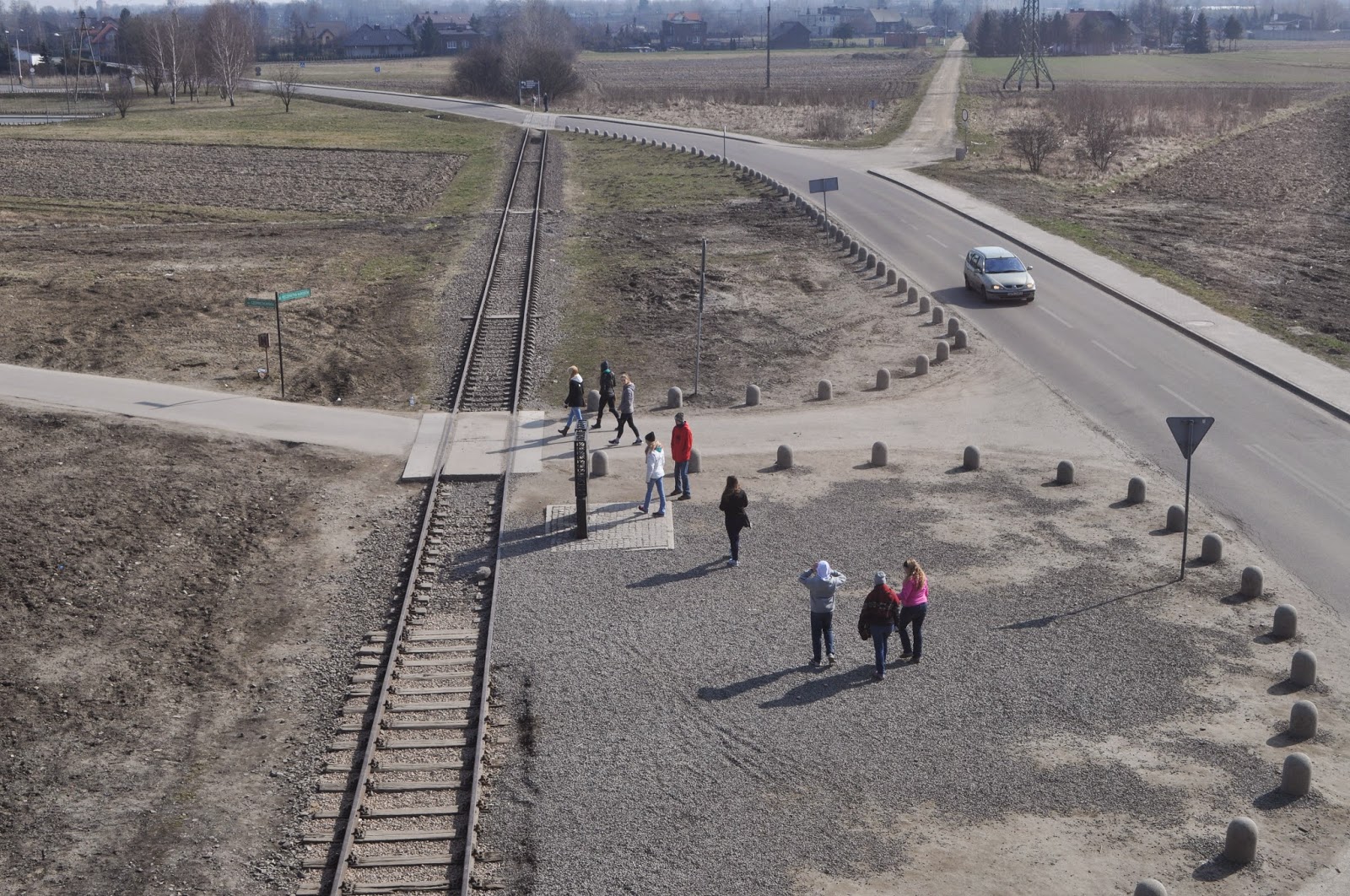
Students cross the tracks one last time, walking quietly (oh, so quietly) back to the bus.  We were so grateful for the nice weather, which allowed us to use the fresh air to sit outside and process.

We again had some time in the sunshine before boarding the bus.  Students had a ton of questions, so Gus and I switched into teacher mode, talking extensively about anti-Semitism before and after the war, the liberation process, and even into the creation of the nation of Israel.  The history lesson in the sunshine served both to put into context what students were seeing (putting names such as Anne Frank to the site also helped) and to help them process the sites.  We boarded the bus around noon and spent the first hour of our drive in quiet time, with students free to process in whispered conversations, sleep, distraction, or reflection.  It was a sobering morning, but one they will remember for a long time.

I will blog about Prague either tonight or tomorrow as the students fly home.  I will add a final post later this week that will consist primarily of photos as students have requested this.  I promise the next post will be a MUCH happier one, as it seems Prague was the favorite city!