Friday, March 20, 2015

IHS in Krakow

Onward!  We left Warsaw by bus on Thursday morning.  The trip began with the Canadians playing music that led to a big jam session.  We stopped for gas and snacks, and then it was movie time for the next part of the trip.  We watched The Pianist, a movie about Wladislaw Szpilman, a Jewish pianist in WWII Warsaw.  We watched as he survived the ghetto, as his family was taken from the Umschlagplatz we had visited, as he hid in an apartment during the ghetto uprising of '43 and again in the Warsaw uprising of '44.  We saw him taking shelter in the hospital, one of only a few buildings to survive and which we had walked past the previous day on our tour (parts of the movie were actually filmed in those streets).  The movie brought to life all of the pieces we had seen, and though it is dark, students commented that they appreciated it.

We stopped briefly at a rest area, then headed to our hotel in Krakow, the city of dragons. This time we were right by old town--a short walk took us to the city walls and then on to the main square in Old Town Krakow (another UNESCO site).  We didn't linger, though--we passed on through to the south side of old town and to Wawel Hill and the impressive castle overlooking the Vistula.  This castle was in use 250 years before Columbus and was no longer in use by 1600.  It was impressive to say the least.  We had an hour or so to explore the castle and surrounding area, and we enjoyed that, though apparently we couldn't get in because of a funeral.  But the grounds and courtyard were impressive nonetheless, and a few of us grabbed a hot chocolate at the cafe up there.

Kendra, Hailey, Justice at Old Town Square, meeting the carriage horses, and avoiding the wind


At Wawel Castle

 Then it was off to dinner, which involved a walk through the old Jewish quarter.  I realized I had left my wallet at the cafe, but our guide Viki called the castle and learned that it was in the security offices.  So after dinner the group returned to the hotel while I went back to the castle to retrieve my wallet. This turned out to be ironically fortuitous, as the place is closed at night.  However, I got buzzed in and took the opportunity to snap a few photos of the castle at night, something tourists don't get to see.


While we had the opportunity to go to the (HUGE) mall across the street, our students were tired and mostly opted for in-room facials, Polish soccer on TV, and sleep.  Can't say I blame them!

This morning we did something a bit different.  While the Canadian group did a more formal walking tour of the Jewish quarter, we broke off and headed across the road to the Rakowicki Cemetery.  This place is interesting and beautiful in its own right, but we were particularly interested in finding the grave of Wislawa Szymborska, one of the poets we study senior year.  Our five seniors, who have already studied Szymborska's works, were particularly interested, and our underclassmen enjoyed learning from the others about the poet.  Then it was off to meet the group.  As we had to go clear across town, we decided to try the streetcars.  The cemetery porter was somewhat helpful, but he spoke NO English.  It took a few tries to get a group ticket as the machine kept spitting the coins back out at me, but in the end and with a lot of laughs we managed it.  Gus and I even successfully navigated the system without a single wrong turn, and we passed the Canadians on foot just before getting off, allowing us to meet up with them easily.
The seniors "meet" Szymborska


At the cemetery

Aaron, Sarah, Justice, and Kaela navigate the trams

Our destination was the Schindler factory.  Students learned about Schindler and how he used his factory to save the lives of over 1,000 Jews of Krakow.  The factory itself is gone, but the office building remains.  The museum began with life in Krakow in the summer of 1939, just before the invasion, and showed us what life was like in the days of Nazi occupation.  We learned about daily life in various stages of the war, both for the Jews of the city and their non-Jewish neighbors.  We saw both a mock up (used for the movie) and the actual offices of Oskar Schindler, saw how those in the city hid both arms and Jews, saw original source material, learned about the ghetto pharmacist Tadeusz Pankiewicz, and sat in a railway station listening to the news of about the bombing of Poland.   It was an incredibly experiential museum that took the entire group from the free days of the 1930s to the arrival of the Red Army and the beginning of the USSR's influence.

The museum ended with the Room of Choices, a round room with inscriptions describing the choices people made and their impact--giving a loaf of bread to a neighbor, laughing as a beard was cut off a Jewish rabbi, etc.  It was a powerful ending to remind us that we can each make choices every day, and each of those choices has an impact on the human beings around us.  Gus and I are grateful every day that we teach at IHS, where our students learn these values, but more significantly, they come with these values already a part of their consciousness.  We have no doubt that each of these students would have their deeds listed in the white book of the museum rather than the black one.


In the mock train station listening to the news of the invasion of Poland

This jarring replica helped us understand what life was like in occupied Poland

Schindler's office (the map is original)

No flash allowed, so a bit blurry, but students learned about the Katyn massacre

Room of Choices
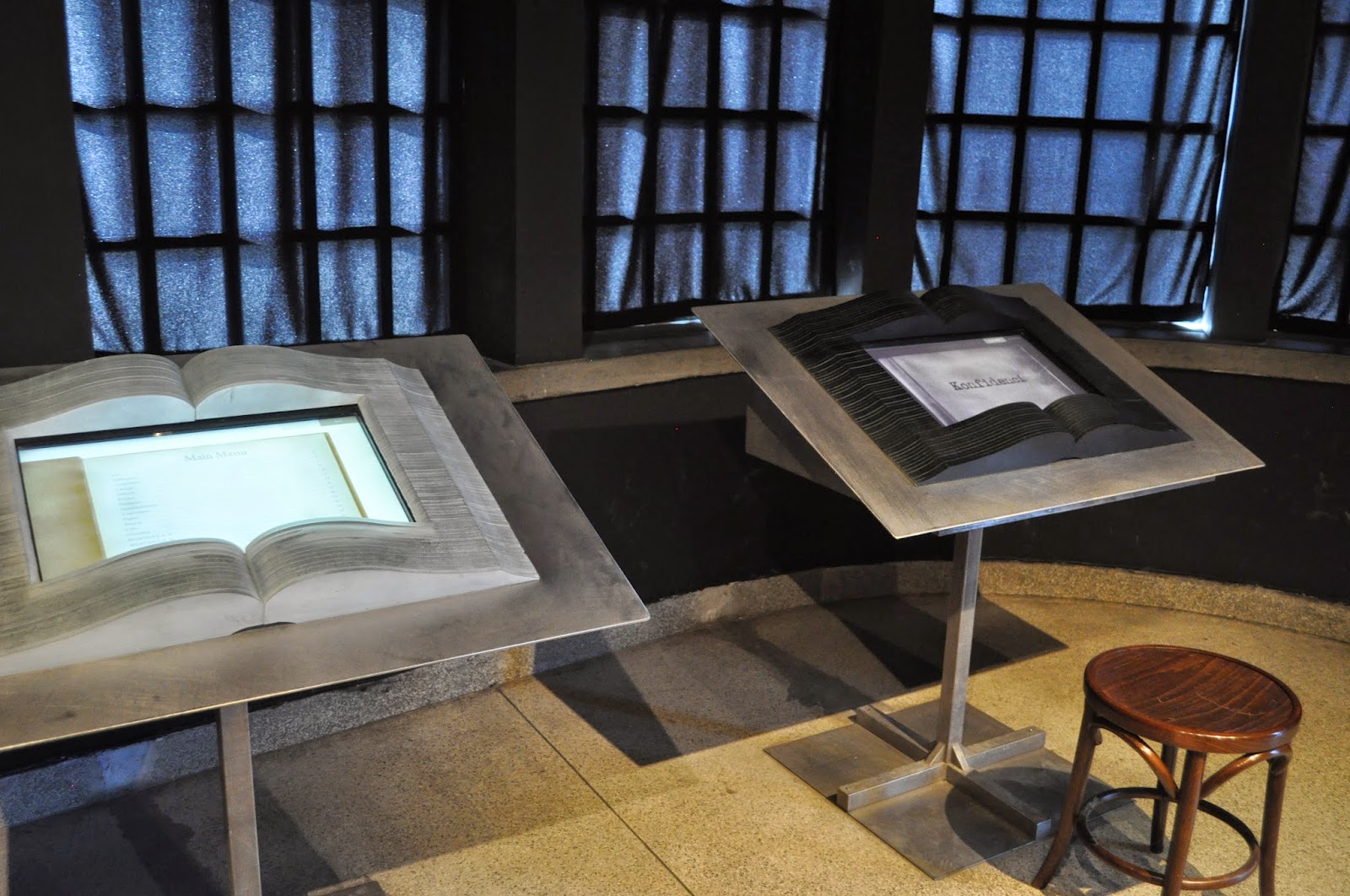
In which book are your deeds?  Interactive display with real stories of choices people made

After this thought provoking visit, hunger became the main focus.  We took advantage of our group ticket and took the tram back into Old Town, where we had free time for the afternoon.  We split into pairs and small groups to have lunch and explore.  Some of us opted for carriage rides, while others went shopping in the big market in the center of the square.  Naps in the sunshine, visits to the cathedral, hot chocolate in the cafes, gelato and a stroll back to Wawel Hill, The house of John Paul II, and an exploration of the park were part of the day as everyone got a chance to see and explore at their own pace.  We met back up for dinner, which was vegetable soup and pierogi (Polish dumplings).  Since dinner was just off the square, we got to walk through it after dark.  The whole place has a different feel and look, and it is stunning.
Our fearless leader takes a nap in the square

Trying gelato

Our group (a bit fuzzy) by the clock that says IHS

Alex and Kendra try pierogi

We have an early morning and a long day tomorrow, both physically and emotionally--tomorrow we head to Auschwitz before we drive to Prague.  Expect the next blog post from there!

Wednesday, March 18, 2015

IHS in Warsaw

Well, the adventures continued into our new city!  First, though, we have to say what a great group this is.  Everyone is mellow, kind, inclusive, enthusiastic, and polite.  They have been so much fun, and the Canadian teachers have complimented our group.

We left Berlin on Tuesday morning.  Our bus took us to the main train station, where we boarded the Berlin-Warsaw EuroCity train.  Students loved this because it reminded them of Harry Potter--six to a compartment.  After a bit of heaving luggage, we settled in.  The coffee cart came by a few times (you have to pay in Germany but not in Poland), and lunch was served in the restaurant car.  From the train we got to see a fair bit of the Polish countryside, including the Swiebodzin Christ the King statue, which is 108 feet tall (making it the largest Jesus statue in the world, 3m taller than the one in Rio).  The trip took about six hours, but it was fun--we had a good time socializing, laughing, sharing the German candy we had brought along, reading, having lunch in the restaurant car, and napping.  Trains are a great and comfortable way to travel--check out the proof below!


 We arrived in Warsaw and were instantly impressed.  The city is very modern, and it is full of interesting buildings.  However, it was the Old Town Warsaw, a UNESCO World Heritage site, that took everyone's breath away.  After a short walking tour and information about the Warsaw Uprising of 1944 (not to be confused with the ghetto uprising of '43), we were given some free time to explore the old town.  Changing money into zloty took us down some random hallway, but we got it sorted quickly.  The old town was breathtaking, but since over 85% of Warsaw was destroyed in WWII, it is a reconstruction, with buildings stolen from towns around Poland for its construction!  Even so it isn't uncommon to find places all over the city still sporting patches or pock marks from bullets.

Viki, our guide, tells us about the Old Town


Aaron and Jacob learn about the construction of the town

Kaela and Justice will tell you that the mermaid is the symbol of Warsaw

Heading down the wall to the fortress gates, which were outdated by the time they were completed.

American, Canadian, Canadian, American

Hailey touches the 3D map of town

Sarah and Aaron are enjoying themselves, too!

Justice, open your eyes!

Beneath the column with the miraculously undamaged statue!

 After a dinner at the hotel, students crashed once again.  They awoke ready to take on Warsaw!  We began with a trip to the Jewish Historical Institute, where we viewed a film about the Jewish Ghetto in Warsaw during WWII, then saw art which forward-thinking ghetto Jews had hidden in secret archives as their legacy.  It was pretty powerful.  A quick stop at the local bakery and market for snacks fueled us for our bus tour with Jan, our local guide.  We visited the grimmer sites such as the Umschlagplatz, where Jews were deported from the ghetto to death camps, and the various memorials to people like Janusz Korczak, orphan caretaker of the ghetto (he was to be spared deportation, but chose to go with his children on the transport and probably to be gassed with them).  18 Mila Street was the hill that is a memorial to Mordechaj Anielewicz, leader of the ghetto uprising, and others.  We also saw the memorial to the righteous and the statue of Jan Karski, a diplomat in Poland's exiled government.

Jan explains the significance of Mila 18

Kaela, Sarah, and Jacob learn about the Ghetto Uprising


After this grim history, we headed to a different section of town and saw the statue of Jozef Pilsudski, the garden with its tribute to Polish composer Chopin, and the Lazeinki Krolewskie palace (I hope I spelled that right!) Students laughed as Jan told them of a Russian minister to Poland who had to flee a palace under the poofy skirts of his wife, and they laughed again at the irony that Poland's last king was forced into exile when the country was invaded by his ex-lover, Catherine the Great.  He fled to Russia.  Jan was a wonderful storyteller!  Our bus tour took us by examples of Soviet architecture, modern pavilions, and back to the Old Town, where we had a few more hours of free time to explore the church, the gift shops, the cafes, and more.  Then it was back to the hotel for a rest.  Because tomorrow's lunch options are limited, we took the time to walk across the street to the local shopping mall and grocery store.  Students got to experience a slice of Polish life as nobody there spoke English!  We picked up snacks, checked out some of the shops, and generally looked around before heading back to the hotel for dinner and a mixer game with our Canadian friends.  Good times!

Gus, as the only person in the group with any sort of mustache, was the only "man" in the group by old Polish standards.  He would have been allowed to carry a sword.  Scary thought.

Learning so much and loving it!

Tess and Sera like the gardens, but Serren especially loved the birds

Kaela and Kendra like the weather

Our group at the palace, where we were photobombed by Japanese diplomats who had just ended their meeting inside!

Alex tries pierogi, a traditional dumpling dish that was excellent!

Gus sitting in a cafe in Old Town Warsaw

Tomorrow it's off to Krakow.  Students commented to us that they learned so much today, and the lovely weather we've been having has only made it more enjoyable!

Monday, March 16, 2015

Eugene IHS in Berlin

So after many moons of being silent on this blog, it is time to begin anew.  I have included mostly pictures of the students rather than the sights; they can show you their pictures of those when they get home and tell you all about it!

Saturday morning was the start of a long day for the lucky few going on our spring break trip.  After meeting at the Portland Airport at 8AM, checking in, and a game of 2 Truths and a Lie, the group flew out.  Things got exciting after an easy transfer in SFO and a long flight to Frankfurt when a bizarre mixup led to the plane being held on the tarmac.  The resulting missed connection was rectified, and the group finally arrived in Berlin on Sunday, tired and a bit delayed, but no worse for wear.

Gus, Kendra, Kaela, Sera, and Tess playing 2 Truths and a Lie in PDX

After dumping our bags in the hotel in Spandau in western Berlin, we hopped a train to the Alexanderplatz, the square that served as a major hub of East Berlin and that is now a bustling area.  There we met up with the other part of our tour group--a school from near Ottawa, Canada.  We walked down past the Neptune Fountain to Hackische Hoefe, a series of interesting and artsy courtyards, which we explored briefly before heading to our dinner location--just next door to Schloss Charlottenburg.  By then we were tired after two days of travel and sightseeing, and we returned to the hotel by 8:15.  By 9:00 we are pretty sure everyone was asleep.


Kaela, Kendra, Justice, and Alex waiting for the train

Sera, Tess, and Serren enjoyed the Hackische Hoefe

Serren, Justice, Alex, Kendra, and Kaela at dinner

This morning we experienced a typical German breakfast--bread rolls (Broetchen) and cold cuts, cheese, fruit, cereal, and eggs.  Then it was back on the subway to Checkpoint Charlie, where we learned about the Cold War, the Berlin Wall, escape attempts, and many other interesting things.  Since we were given free time, some of us went souvenir shopping while others wandered the neighborhood enjoying the lovely weather.  A few of us made it to the Topography of Terror museum, which houses exhibits about the SS and is situated on top of the old SS headquarters site.  It sits next to a long section of the wall which is still intact.  After lunch, we headed over to the Jewish Museum, which tells not only of the Holocaust, but of the history of Jews in Germany over many centuries.  This was completely fascinating.

Hailey celebrated her 18th birthday today--at Checkpoint Charlie!

Gus teaching Alex and Justice about the history of the Wall--while standing at the Wall (behind me, not in the picture).  Think they are learning anything on this trip?


Walking back after Topography of Terror--did you know that a family once escaped East Berlin by zip lining from the building on our left (a ministry building) over the Wall (on our right) on a homemade harness and line?

The Memory Void exhibit in the Jewish Museum--the idea is to walk across the metal faces without making any noise.  Can't be done.  Powerful exhibit.

After so long on our feet, we were glad to do a bus tour.  Our local guide was an Oregonian(!) who has lived in Berlin since 1960 and was a long time State Department employee--he used Checkpoint Charlie almost daily.  Our bus tour took us to the Bayerischer Platz, a former Jewish district that is still pretty today; there we took a short walk around the neighborhood and saw the placards that explained the laws passed to restrict the rights of Jews over the years under National Socialism.  Students got a kick out of watching local children on the playground, too.  Once back on the bus we headed over to Gruenewald, a beautiful villa district and home to the Gleis 17 Memorial.  It was from this train station in the upscale neighborhood that many of Berlin's Jews departed on their way to ghettos in Lodz or concentration camps like Theresienstadt.  While the memorial is somewhat dark, the villas, lovely scenery, and phone booth library all served to lighten the atmosphere.

Here we are with our Canadian friends.

Our drive then took us up the Kurfuerstendamm, West Berlin's main boulevard, past the KaDeWe (Kaufhaus des Westens, the Harrod's of Berlin), the Kaiser Wilhelm Memorial Church, and Embassy Row.  We hopped out and walked across the Holocaust memorial, which is a series of stones among which people can easily lose each other.  We kept walking past the American Embassy to the Brandenburg Gate and the Tiergarten.  We also saw the Hotel Adlon of Michael Jackson dangling baby fame.  We got back on the bus and drove down Unter den Linden, the primary boulevard of a reunited Berlin, across the Spree and past the Berliner Dom (the major cathedral), the Alexanderplatz, and Hackische Hoefe to our dinner destination just next door to the old synagogue.  Then we had a short free time to wander and do a bit more shopping before heading back to the hotel on the train, where Sera and her suitcase shared a joyful reunion.

Serren, Tess, and Sera review the day's pictures on the train back to Spandau

Tomorrow we head to Warsaw.  We are excited about our long train ride--what a great way to see the countryside!  We've been enjoying getting to know the Canadians, and while students loved Berlin and want to stay and experience so much more, they are also ready to see what the next city has to offer.  Stay tuned for our next update, this time from Poland.